
-
Published by: The Wellbeing Research Centre at the University of Oxford, in partnership with Gallup and the UN Sustainable Development Solutions Network (UNSDSN).
-
Published on: 19 March 2026 (Released annually around the International Day of Happiness, March 20).
-
2026 Theme: "Happiness and Social Media".
-
Method: Country rankings were based on answers given by around 100,000 people in more than 140 countries and territories who were asked to rate their own lives.
- It asks people to rate their life on a 0-10 scale, from the worst possible life (0) to the best possible life (10).
- As per the report, the six factors to explain life evaluations:
-
- Social Support/ Having someone to count on
- GDP per capita
- Healthy life expectancy
- Freedom to make life choices
- Generosity
- Perception of corruption
-
Top - 1. Finland (continuously 9th time) 2.Iceland 3. Denmark 4. Costa Rica (Previously ranked 23) 5. Sweden.
-
Bottom 3 ranked countries: Afghanistan, Sierra Leone, Malawi
-
India- 116th out of 147 countries, marginal improvement from 118th in 2025 and 126th in 2024. Life Evaluation Score: 4.536 out of 10
-
Strengths: Perception of corruption (64th), Generosity (78th), and Freedom (61st).
-
Weaknesses: Social support (123rd) and GDP per capita (89th) are major drags on the overall score.
-
Regional Comparison: India lags behind China(65th), Nepal (99th) and Pakistan (104th) but ranks ahead of Bangladesh (127th) and Sri Lanka (134th).
-
Findings:
-
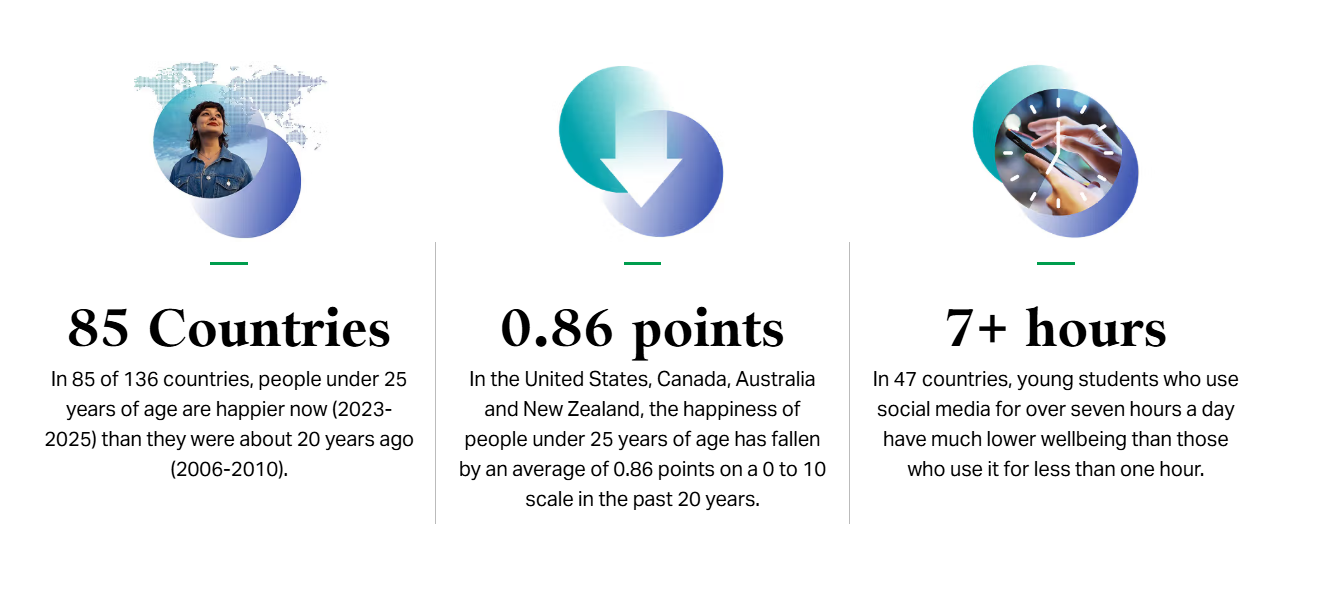
This report conclude that heavy users of social media are at risk, especially in English-speaking countries and Western Europe.
-
A strong negative correlation exists between excessive social media use and well-being, particularly among adolescent girls.
-
79 countries recorded gains in happiness levels despite rising geopolitical tensions.
-
Platforms driven by algorithmic feeds, influencers, and visual content are most harmful, as they encourage social comparison, while communication-focused platforms are associated with better outcomes.
- According to the report, wealth inequality is greater in India, with the richest 10 per cent holding around 65 per cent of total wealth and the top 1 per cent holding about 40 per cent.
Q. Consider the following statements regarding the World Happiness Report 2026:
(I) This report is published by the Wellbeing Research Centre at the University of Oxford in partnership with Gallup and the World Bank.
(II) Six key factors, including 'GDP per capita' and 'perceptions of corruption', are used to determine the ranking of countries.
(III) India's ranking in this report has improved compared to the previous year (2025), but it still lags behind its neighboring countries Nepal and Pakistan.
Which of the statement/s given above is/are correct?
(1) (I), (II) and (III)
(2) Only (III)
(3) Only (II) and (III)
(4) Only (I) and (II)
(5) Question not attempted
Answer: Option (3)