
Background
-
India's maritime sector is crucial to its economy and trade.
-
It handles about 95% of the country's trade by volume and approximately 70% by value.
-
The nation has an extensive coastline of around 11,099 kilometres.
-
It also possesses nearly 14,500 kilometres of potentially navigable waterways.
-
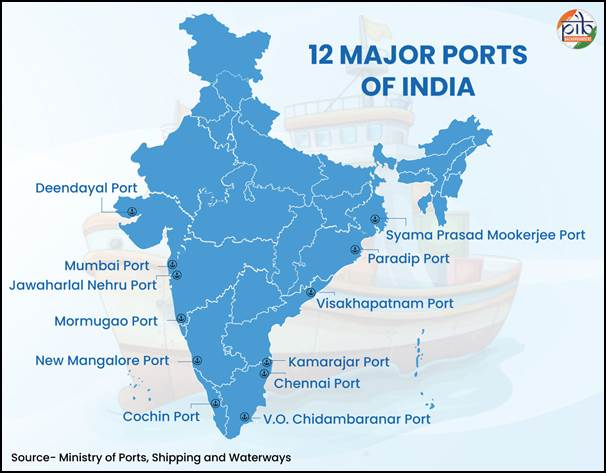
India has 12 major ports (under Ministry of Ports, Shipping & Waterways) and 200+ non-major ports (under State Maritime Boards)
Sagarmala Programme
-
Launched: March, 2015
-
Aims: To improve logistics efficiency, reduce transportation costs, and support trade by increasing the use of coastal shipping and inland waterways alongside existing road and rail networks
-
Key Objectives
-
Reduce logistics cost for EXIM and domestic trade with minimal infrastructure investment.
-
Lower logistics costs of bulk commodities by locating industries close to coast.
-
Create jobs and develop skills in ports and maritime sector
-
Enhanced domestic waterways (inland and coastal) in the multi-modal transport.
-
Components of the Sagarmala
-
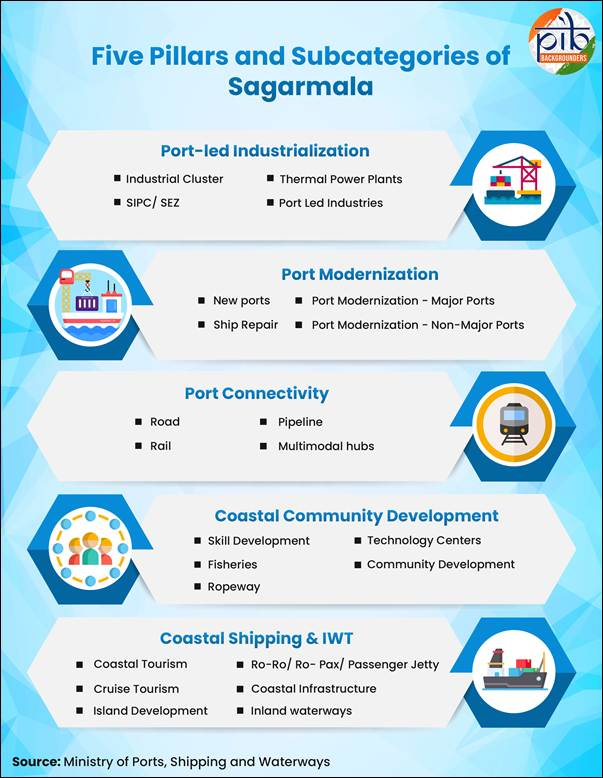
The Sagarmala Programme's projects fall under 5 pillars and 24 categories.
-
Port Modernization and New Port Development
-
Port Connectivity Enhancement
-
Port-Led Industrialization
-
Coastal Community Development
-
Coastal Shipping and Inland Waterways Transport
Achievements
-
Around 845 projects, estimated at ₹6.06 lakh crore, have been taken up under the programme. As of 24th March 2026, 315 projects worth ₹1.57 lakh crore have been completed, while 210 projects are currently under implementation, and 320 projects are in the planning stage.
-
Record cargo handling: 915.17 MT in FY 2025–26 (target was 904 MT); YoY growth of 7.06%
-
Vessel turnaround time reduced: 96 hrs (2014) → 49.5 hrs (2025)
-
Global Recognition: 9 Indian ports rank among world's top 100; Visakhapatnam in top 20 for container traffic
-
Cumulative employment potential of this programme: around 1 crore jobs, including 40 lakh direct and 60 lakh indirect employment opportunities.
Institutional Support
-
The Sagarmala Programme is supported by a multi-tier framework designed to enable coordinated planning, efficient implementation, and continuous monitoring across the Centre and States. The key components of this framework are as follows:
-
National Sagarmala Apex Committee (NSAC)
-
Maritime States Development Council (MSDC)
-
State Sagarmala Committees (SSCs)
-
Sagarmala Finance Corporation Limited (SMFCL)
Sagarmala 2.0
-
Next phase building on Sagarmala 2015, aligned with Maritime India Vision (MIV) 2030 and Maritime Amrit Kaal Vision (MAKV) 2047
-
Goal: make India a global maritime hub
-
Budgetary support: ₹85,482 crore; total investment target: ₹3.6 lakh crore
-
Aligned with Viksit Bharat 2047 - inclusive growth, employment, logistics cost reduction
-
Focus areas: identified interventions across ports, inland waterways & coastal infrastructure, maritime services, coastal development, research & development and institutional strengthening during the scheme period.
Conclusion
-
India’s maritime sector has seen significant expansion in capacity, connectivity, and operational efficiency over the past decade. The Sagarmala Programme provides a structured approach to sustaining growth and strengthening India’s maritime infrastructure for trade and industrial activities.
Note: As per Ministry of Ports, Shipping, and Waterways-
- There are 14 notified major ports out of which 12 Major Ports are in Operation.
- Out of the 200 non-major ports, around 65 ports are handling cargo and the others are “Port Limits” where no cargo is handled and these are used by fishing vessels and by small ferries to carry passengers across the creeks etc.
Source: PIB