1. Introduction & Context
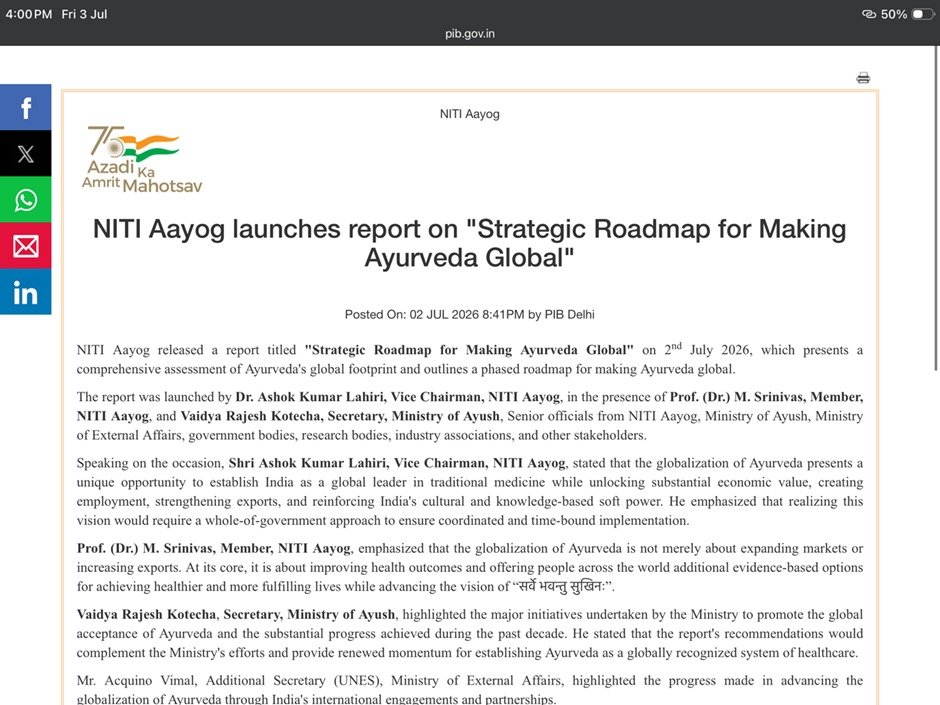
- The Report- Formulated by the Health Division of NITI Aayog in collaboration with PricewaterhouseCoopers (PwC).
- Objective- To transition Ayurveda from a largely product-driven traditional remedy into a scientifically credible, evidence-based, and globally integrated system of mainstream healthcare by 2047.
- Vision Alignment- Tied directly to India's broader development vision of Viksit Bharat@2047.
- The Economic Backdrop- Ayush product exports doubled from USD 1.09 billion in 2014 to USD 2.16 billion in 2023, reaching around 150 countries. However, most exports are limited to lower-value "dietary supplements" due to a lack of recognized medicinal validation overseas.
2. The Core Three-Pillar Framework
- The NITI Aayog roadmap structures the globalization of Ayurveda around three distinct strategic dimensions-
I. Availability (Expanding Infrastructure & Workforce)
- Addressing Imbalances: Currently, 95% of qualified Ayurveda practitioners are concentrated in India. The roadmap seeks to enhance international education and practitioner mobility.
- Manufacturing Standards: Mandates upgrading Indian production units to match WHO-GMP (Good Manufacturing Practices) equivalence.
- Export Diversification: Developing an export-focused Ayurvedic Pharmacopoeia with clear chemical fingerprinting and stability testing data to switch from raw materials to high-value finished medicines.
II. Acceptability (Building Scientific & Legal Legitimacy)
- Evidence-Based Validation: Transitioning the narrative through multi-country clinical trials, real-world data registries, and publishing Annual Global Ayurveda Evidence & Safety Reports.
- Global Register: Proposing a Global Ayurveda Register (GAR) integrated with WHO-aligned digital credentials to verify cross-border practitioners seamlessly.
- Insurance Portability: Collaborating with regulatory bodies to include targeted Ayurvedic therapies (e.g., metabolic syndrome, osteoarthritis, stress management) under insurance reimbursement schemes in at least 10 countries.
III. Propagation (Branding & Medical Travel Integration)-
- Medical Value Travel (MVT): Establishing specialized Ayurvedic MVT zones in India and creating bundled Ayush Visa packages that offer end-to-end support (diagnosis, treatment, and virtual telemedicine follow-ups).
- Diplomatic Integration: Empowering Indian embassies as interactive information hubs and opening premium Ayurveda Experience Centres across iconic international locations (e.g., Geneva, London, New York, Tokyo, Singapore).
3. Phased Phasing Timeline to 2047-
- Rather than an immediate branding campaign, the strategy implements a structured, phased methodology:
- Short-Term (Up to 2029): Build foundational networks; establish an inter-ministerial Mission Steering Group; expand Ayush Visa access; scale compliance with WHO-GMP standards.
- Medium-Term (Up to 2035): Establish 10 International Ayurveda Centres of Excellence globally (across Europe, North America, Southeast Asia, Australia, and the Gulf) combining clinical practice with quality assurance labs.
- Long-Term (Up to 2047): Formalize integration of Ayurveda into national healthcare frameworks of at least 20 partner countries with structured practice pathways.
4. Strategic Institutional Recommendations
- Global Collaborations: Forging Mutual Recognition Arrangements (MRAs) with influential blocks (G20, BRICS, ASEAN) and introducing Ayurveda electives in mainstream foreign medical colleges.
- Protecting Traditional Wealth: Modernizing the Traditional Knowledge Digital Library (TKDL) and introducing a predictive "patent watch mechanism" to suppress biopiracy and false international patent claims on ancient remedies.
- Unified Bodies: Setting up a World Federation for Ayurveda and Yoga, expanding the Ayush Export Promotion Council, and establishing a real-time Ayurveda Trade Dashboard.
Source: PIB