
The rise of Saddam Hussein:-
•Early Radicalization and the Ba'ath Party (1950s)
•Born into a poor family in a village near Tikrit, Saddam was deeply influenced by Arab nationalism in his youth.
• Joining the Party:
-In 1957, at age 20, he joined theBa'ath Party, a secular, Arab nationalist political movement that sought to unite the Arab world.
•The Failed Assassination (1959):
-In 1959, Saddam was part of a Ba'athist hit squad that attempted to assassinate Iraq's then-ruler, Prime Minister Abd alKarim Qasim. The plot failed, and Saddam was wounded in the leg. He famously fled across the desert to Syria and eventually to Egypt, where he lived in exile. This event cemented his reputation within the party as a man of action and a committed revolutionary.
The 1968 Coup: The Man Behind the Throne:-
- After years of political instability and shifting governments, the Ba'ath Party successfully seized power in a bloodless coup in July 1968.
- The Dynamic Duo: The leader of the coup and the new President of Iraq was Ahmed Hassan al-Bakr, an older military general who was also a distant relative of Saddam.
- The Deputy: Al-Bakr appointed the 31-year-old Saddam Hussein as Vice President and Deputy Chairman of the Revolutionary Command Council (RCC). While al-Bakr was the public face of the government, Saddam quickly became the administrative workhorse and the real power broker behind the scenes.
• Consolidating Power (1968–1979):-
- During his 11 years as Deputy, Saddam strategically built an unbreakable power base by controlling the three most important pillars of the Iraqi state: security, the economy, and the party apparatus.
- Building the Security Apparatus: Saddam's most critical move was taking absolute control of Iraq's internal security. He created a formidable intelligence network (the Mukhabarat) and a massive paramilitary force completely loyal to him, independent of the regular military. This allowed him to spy on, intimidate, and eliminate any potential rivals before they could organise.
- Nationalising the Oil (1972): In 1972, Saddam spearheaded the nationalization of the Iraq Petroleum Company, which had previously been controlled by Western interests. Coinciding with the 1973 global energy crisis, this move brought unimaginable wealth into the Iraqi state.
The Golden Era: Saddam used this oil money to launch massive national development programs. He built roads, schools, and hospitals, and initiated a highly successful national literacy campaign. This made him genuinely popular among many Iraqis and cemented the Ba'ath Party's control over the population. He presented himself as a moderniser and a champion of the Iraqi people.
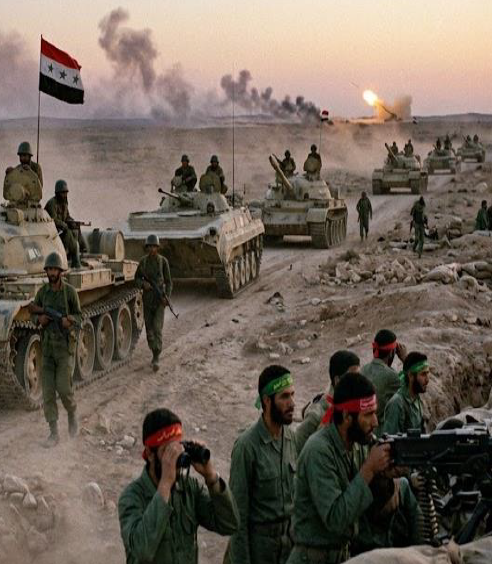
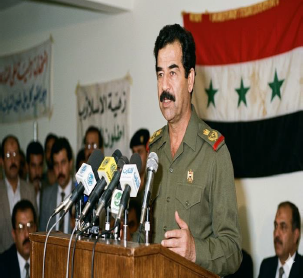
The Iran-Iraq War (September 1980 – August 1988)• Causes of the War • While territorial disputes had existed for decades, the war was ultimately triggered by the massive geopolitical shift caused by the 1979 Islamic Revolution in Iran. • Saddam's Opportunism: Following the 1979 revolution, Iran's military was in chaos. Many of the Shah’s top generals had been executed or had fled, and the country was internationally isolated due to the US Embassy hostage crisis. Saddam Hussein saw a golden opportunity to strike a weakened neighbour and establish Iraq as the dominant power in the Persian Gulf. • Territorial Disputes: Saddam aimed to seize full control of the Shatt al-Arab (the vital waterway that forms the border between the two countries and serves as Iraq's primary outlet to the sea) and to annex Iran's oilrich Khuzestan province, which had a large Arab population. • Fear of Revolution: Saddam Hussein ran a secular government dominated by the Sunni Arab minority, but Iraq had a massive Shia Muslim majority. He deeply feared that Ayatollah Khomeini would successfully export his Shia Islamic revolution across the border and incite the Iraqi Shia population to overthrow the Ba'ath party. |
 |
 |
The decline and ultimate fall of Saddam Hussein:-
- The Catalyst: The Gulf War and Loss of Regional Power (1991)
Saddam’s absolute grip on power first cracked following his ill-fated invasion of Kuwait in 1990. - The Era of Containment and Sanctions (1991–2003)
Though he survived the Gulf War, Saddam spent the 1990s as an international pariah, confined to his own borders. - The Post-9/11 Shift and the 2003 Invasion
The September 11, 2001, terrorist attacks in the United States dramatically changed American foreign policy, directly leading toSaddam's downfall.
• Trial and Execution (2004–2006):-
• Instead of a military tribunal, the US handed Saddam over to the newly formed Iraqi government to be tried by his own people.
• The Trial: He was brought before the Iraqi Special Tribunal. Rather than being tried for the massive atrocities of the Iran-Iraq War or the Halabja chemical attack, the first trial focused on the 1982 Dujail Massacre, where he ordered the torture and execution of 148 Shia men and boys following a failed assassination attempt against him. Throughout the trial, Saddam remained defiant, frequently interrupting the judge and insisting he was still the legitimate president.
• The Verdict and Hanging: In November 2006, he was found guilty of crimes against humanity and sentenced to death by hanging.
• The Execution: On December 30, 2006 (the morning of the Islamic holiday Eid al-Adha),Saddam was executed. Cell phone video secretly recorded by witnesses leaked to the public, showing a chaotic scene where guards taunted the former dictator in his final moments. He refused a hood and was reciting the Islamic declaration of faith (Shahada) when the trapdoor opened.
Why Israel and USA attack on Iran:-
1. Breaking the "Ring of Fire" (The Proxy War) As we discussed regarding Hamas, Iran's primary strategy against
Israel is the "Axis of Resistance." Iran has spent decades funding, arming, and training a network of militias that
physically surround Israel—most notably Hezbollah to the north in Lebanon, Hamas to the south in Gaza, and
various militias in Syria and Iraq.
2. The Nuclear Program (The Existential Threat)
The deepest, most fundamental driver of Israeli hostility toward Iran is the Iranian nuclear program.
- Protecting Regional Allies: The US has deep security alliances with Israel and several Gulf Arab states (like Saudi Arabia and the United Arab Emirates). These Gulf states are historically Sunni Muslim and view Shia-majority Iran as their greatest regional rival. The US opposes the nuclear program to maintain the balance of power and protect these vital allies.
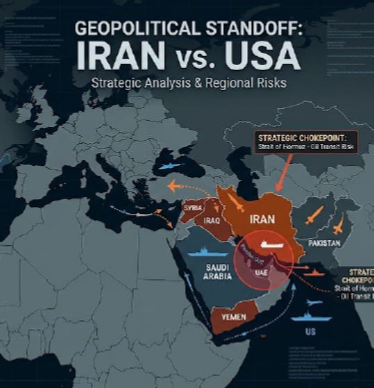
- Economic Security and the Strait of Hormuz: A nuclear-armed Iran would become the undisputed dominant power in the Persian Gulf. Approximately 20% of the world's oil passes through the Strait of Hormuz, which borders Iran. The US fears that a nuclear Iran could dictate terms of global energy shipments and hold the global economy hostage without fear of conventional military retaliation.
Why Israel and USA attack on Iran:-
- Israel’s Perspective: The Existential Threat
For Israel, an Iranian nuclear weapon is not just a strategic or political problem; it is viewed as a direct threat to the survival of the nation.
• Ideological Hostility: Since the 1979 Islamic Revolution, Iran’s leadership has repeatedly and publicly called for the destruction of the State of Israel, referring to it as a "cancerous tumor." Because of this explicit rhetoric, Israel takes the threat of an Iranian nuclear weapon completely literally.
• The Nuclear Umbrella for Proxies: As we discussed earlier, Israel is already fighting a multi-front war against Iran's heavily armed proxy network (Hamas, Hezbollah, the Houthis). Israel fears that if Iran possesses a nuclear weapon, it would provide a "nuclear umbrella" for these groups. Essentially, Israel might be deterred from aggressively fighting these militias out of fear that doing so could provoke a nuclear strike from Tehran.
• The Begin Doctrine: Israel operates under a strict, unwritten military policy known as the "Begin Doctrine," which states that Israel will use preemptive military force to ensure that no sworn enemy ever acquires weapons of mass destruction. (They executed this doctrine by bombing a nuclear reactor in Iraq in 1981 and another in Syria in 2007).
Why Israel and USA attack on Iran:-
| • 3. The Core Disconnect: Trust and Intent • A major part of the opposition stems from a fundamental lack of trust. • Iran has consistently maintained that its nuclear program is strictly forpeaceful purposes, such as generating electricity and producing medical isotopes for cancer treatment. However, the US, Israel, and the International Atomic Energy Agency (IAEA) have documented that Iran had an active nuclear weapons research program until at least 2003. • Furthermore, following the collapse of the 2015 nuclear deal (when the US withdrew in 2018), Iran began enriching uranium to 60% purity. Because civilian nuclear power only requires uranium enriched to about 3–5%, and a nuclear bomb requires 90%, the US and Israel argue there is no plausible civilian justification for Iran's current enrichment levels, viewing it as clear preparation for "breakout" capability (the ability to rapidly build a bomb if the upreme leader decides to do so). |
 |
 |
Strait of Hormuz:-
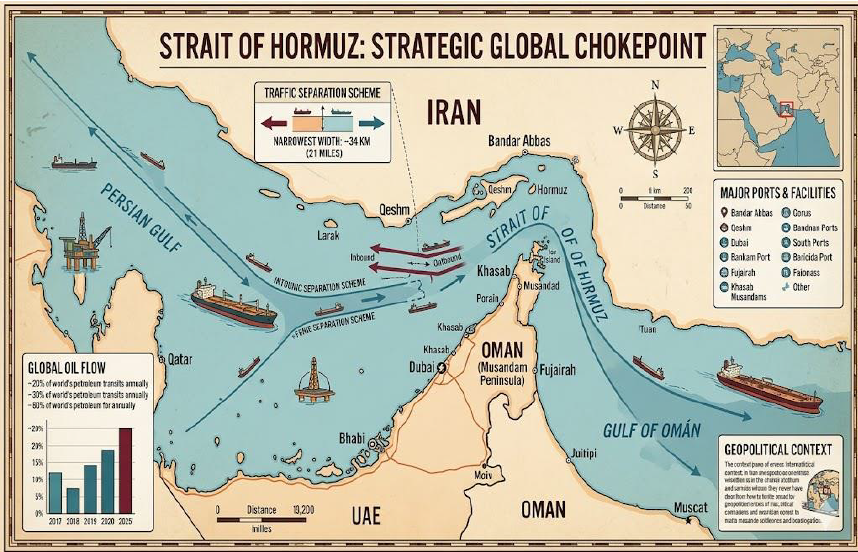
- one of the world's most critical maritime "choke points." Located between Oman and Iran, it connects the Persian Gulf to the Gulf of Oman and the Arabian Sea. It is the only sea passage from the Persian Gulf to the open ocean.
1. The Gateway for Global Energy
Historically, the Strait of Hormuz has been the lifeblood of the global energy market.
- Volume: Prior to the current crisis, approximately 20 million barrels of crude oil and petroleum products passed through the Strait every day. This represents roughly 20% of total global oil consumption and over 30% of all seaborne crude oil trade.
- The Asian Lifeline: The vast majority of this oil heads to Asian markets. Countries like China, India, Japan, and South Korea historically rely on this single, 21-mile-wide passage for a massive portion of their energy supply.
- Vulnerability: Because the navigable shipping channels are only two miles wide in either direction, any military disruption immediately chokes off global supply, causing oil prices to skyrocket.