India-Sweden Bilateral Ties: Green Transition & Industrial Decarbonisation
Read in:AI translation — may contain inaccuracies
Context
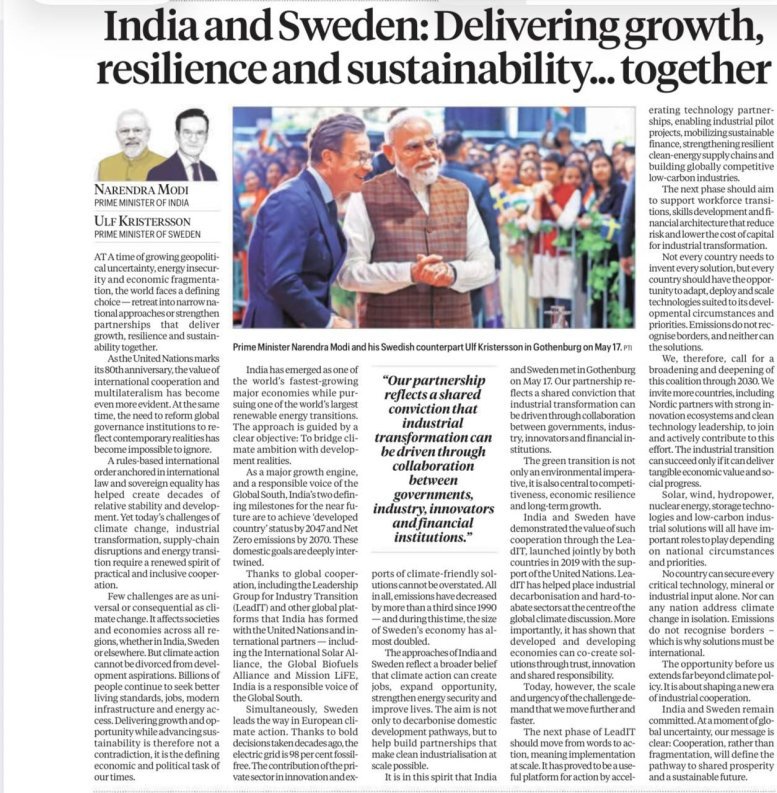
India and Sweden held bilateral discussions in Gothenburg (May 17) to strengthen partnerships delivering growth, resilience, and sustainability amid growing geopolitical and economic fragmentation.
Focus on transitioning from national approaches to practical, inclusive, and international cooperation.
Shared Vision & Global Outlook
Multilateralism & Reform:Emphasized the urgent need to reform global governance institutions to reflect contemporary realities, as the UN marks its 80th anniversary.
Climate Action as an Economic Driver:Both nations reject the notion that sustainability contradicts economic growth. Climate action is framed as a catalyst for job creation, energy security, and improved living standards.
Rules-Based Order:Reaffirmed commitment to an international order anchored in international law and sovereign equality.
Individual Milestones & Commitments
India (Voice of the Global South):
Twin milestones: Achieving 'developed country' status by 2047 and Net Zero emissions by 2070.
Leading global coalitions:International Solar Alliance (ISA), Global Biofuels Alliance, andMission LiFE.
Sweden (European Climate Leader):
Operates a 98% fossil-free electric grid.
Demonstrated "decoupling" of economic growth and emissions: Since 1990, Sweden's emissions have decreased by over a third while its economy has nearly doubled.
The Centerpiece: LeadIT (Leadership Group for Industry Transition)
Background:Launched jointly by India and Sweden in 2019 (with UN support) to focus on industrial decarbonisation, specifically in "hard-to-abate" sectors.
Phase 1 Achievements:Successfully brought industrial transition to the center of global climate discussions, proving developed and developing economies can co-create solutions through trust and shared responsibility.
The Next Phase (Implementation at Scale): Moving from dialogue to action via industrial pilot projects and mobilizing sustainable finance.
Strengthening resilient clean-energy supply chains and building competitive low-carbon industries.
Workforce Transition:Supporting skills development and financial architectures that lower the cost of capital for industrial transformation.
Broadening the coalition through 2030 by inviting Nordic partners with strong innovation and technology ecosystems.
Strategic Takeaways for Future Cooperation
Interdependence:No single country can secure every critical technology or mineral alone. Because emissions do not recognize borders, solutions must be international.
Technology Adaptation:Not every country needs to invent solutions; the focus must be on the opportunity to adapt, deploy, and scale technologies suited to specific developmental circumstances.
Inclusive Energy Mix:Acknowledging that solar, wind, hydropower, nuclear energy, and storage technologies will all play critical roles depending on distinct national priorities.
Core Message:Cooperation, rather than fragmentation, is the defining economic and political pathway to shared prosperity.