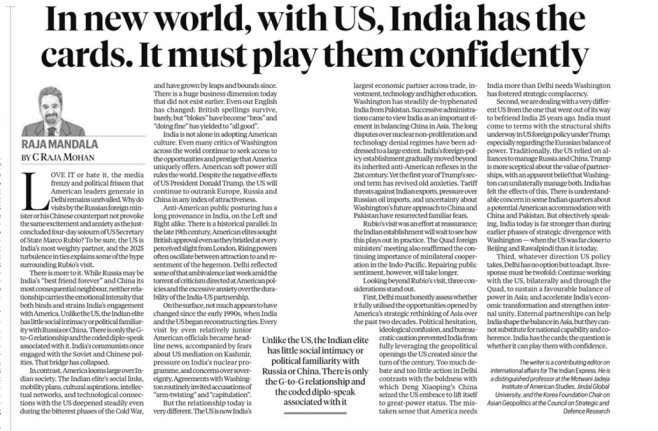
WHY AMERICA LOOMS LARGER THAN RUSSIA OR CHINA IN INDIA'S ELITE CONSCIOUSNESS(core concept / very important )
- Social links India's elite — social links, mobility plans, cultural aspirations, intellectual networks, and technological connections — are deeply tied to America. This has grown by leaps and bounds since the 1990s.
- Language & culture Even India's language has changed — British spellings survive barely, "blokes" have become "bros," "doing fine" has yielded to "all good." American soft power rules India's cultural imagination.
- Business dimension A huge business dimension with the US exists today that simply did not exist earlier — IT industry, diaspora, FDI, higher education partnerships, silicon valley ecosystems.
- US soft power Despite Trump's negative effects, the US will continue to outrank Europe, Russia, and China in global attractiveness. American soft power still rules the world.
- Historical parallel In the late 19th century, Indian elites sought British approval even as they bristled at every perceived slight from London. Rising powers often oscillate between attraction to and resentment of the hegemon.
THE CHANGED RELATIONSHIP
- US de-hyphenated India-Pakistan Washington has steadily de-hyphenated India from Pakistan — successive US administrations came to view India as a critical element in balancing China in Asia. This is structural, not reversible.
- Nuclear disputes resolved Long-standing disputes over nuclear non-proliferation and technology denial regimes have been addressed to a large extent — India's foreign-policy establishment has moved beyond inherited anti-American reflexes.
- India far stronger now India today is far stronger than during earlier phases of strategic divergence with Washington — when the US was far closer to Beijing and Rawalpindi than it is today. India's bargaining position has improved dramatically.
- US needs India more Washington needs India as a partner to balance China in Asia — this gives India genuine leverage it lacked during the Cold War. The asymmetry of need has shifted in India's favour.
- Quad reaffirmed Rubio's visit reaffirmed the continuing importance of minilateral cooperation in the Indo-Pacific through the Quad — despite Trump 2.0's ambiguous signals about the grouping.
TRUMP 2.0 — NEW ANXIETIES FOR INDIA
♦ Tariff threats 25% reciprocal tariff + 25% Russia oil penalty on Indian exports — economic pressure tactic. Resolved partially via Feb 2026 Interim Trade Deal (18% tariff). Shows transactional nature of Trump's diplomacy.
♦ Russia oil pressure Uncertainty about Washington's future approach to Russia — if US-Russia reset happens, India's Russia oil discount window could close. India must diversify energy sources.
♦ China-Pakistan accommodation Fear of potential US accommodation with China AND Pakistan simultaneously — squeezing India. Trump's claim of Kashmir mediation; Xi-Trump meetings. India's concern is structurally valid but India is stronger now to manage it.
♦ Alliance scepticism Trump believes Washington can unilaterally manage Russia and China — reducing value placed on partnerships. 2026 US National Defense Strategy made no mention of India or Quad — a significant omission.
3 KEY CONSIDERATIONS FOR INDIA GOING FORWARD
- Honest self-assessment: Delhi must assess whether it has fully utilised the geopolitical openings America's strategic rethinking of Asia created in the past two decades. Political hesitation, ideological confusion, and bureaucratic caution — contrasted with the boldness with which Deng Xiaoping's China seized the US embrace to lift itself to great-power status — prevented India from maximising these opportunities.
- Adapt to structural shifts in US foreign policy: India must come to terms with the structural shifts underway in US foreign policy under Trump — especially the Eurasian balance of power. Trump is sceptical of alliances; believes Washington can unilaterally manage Russia and China. India has felt this — understandable concern about US accommodation with China and Pakistan. But India is objectively stronger now.
- Twofold response — no option but to adapt: (a) Continue working with the US bilaterally and through the Quad to sustain a favourable balance of power in Asia; (b) Accelerate India's economic transformation and strengthen internal unity. External partnerships can help India shape the balance in Asia — but cannot substitute for national capability and coherence.