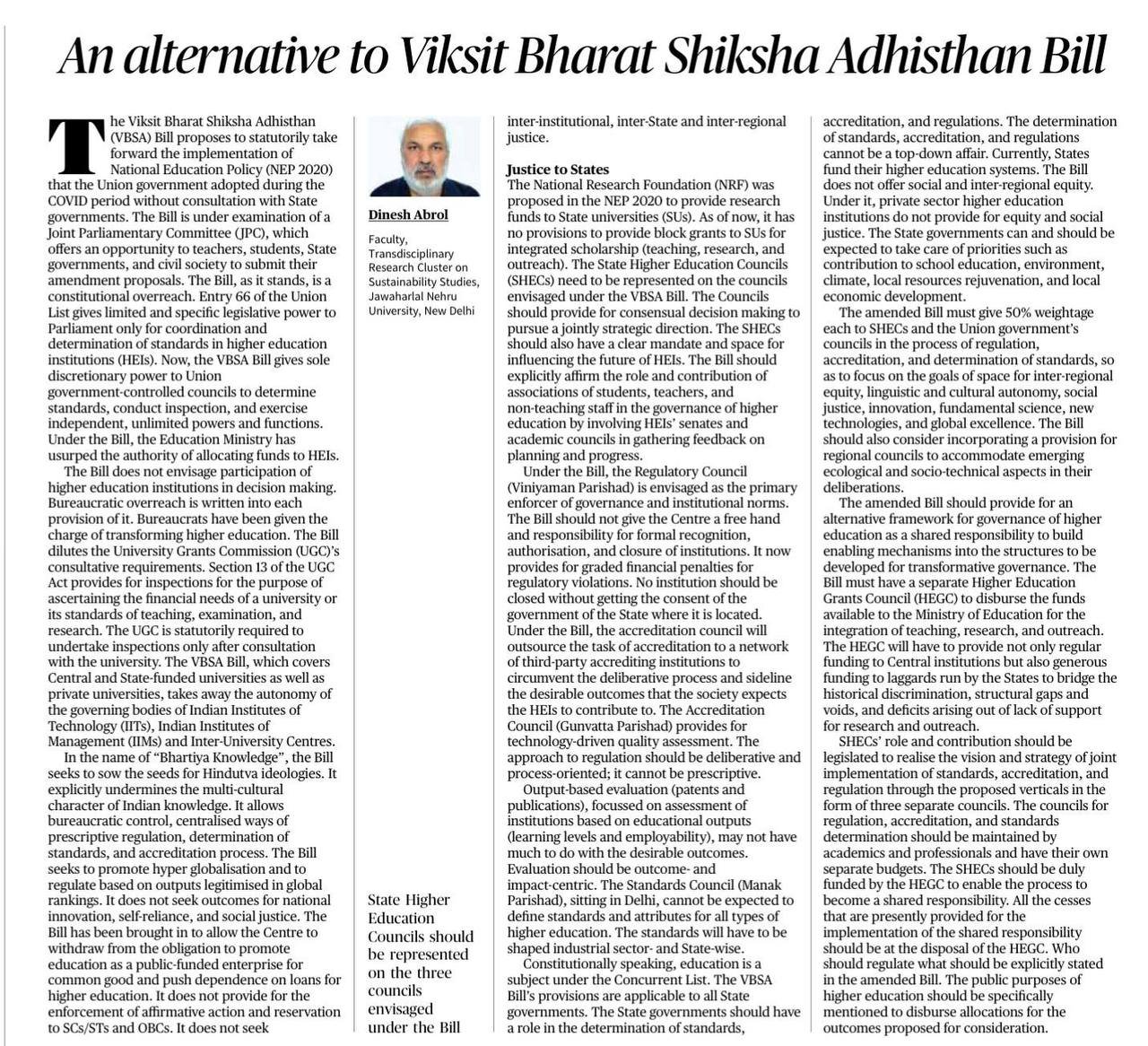
Why is it in the news?
• The proposed Viksit Bharat Shiksha Adhisthan (VBSA) Bill aims to provide a statutory framework for the implementation of the National Education Policy (NEP) 2020).
• However, it has attracted criticism for allegedly centralising authority over higher education and weakening the role of States and universities.
Core concern with the Bill
• The Bill vests extensive powers in Union government-controlled councils to:
• Set academic standards
• Conduct inspections
• Oversee accreditation
• Regulate higher educational institutions
• Critics contend that this exceeds Parliament’s limited authority under Entry 66 of the Union List, which is confined to the coordination and determination of standards.
Why is it considered centralising?
• The Bill is seen as curtailing the autonomy of premier institutions and regulatory bodies such as:
• University Grants Commission (UGC)
• Indian Institutes of Technology (IITs)
• Indian Institutes of Management (IIMs)
• It also marginalises the role of universities, faculty, students, and State governments in institutional decision-making.
• As a result, bureaucratic control is strengthened while consultative mechanisms are weakened.
Federalism-related concerns
• Since education falls under the Concurrent List, State governments must play a substantive role in the regulation and financing of higher education.
• However, the Bill does not ensure adequate participation of State governments or State Higher Education Councils (SHECs).
What alternative has been suggested?
• Critics recommend that State Higher Education Councils should have representation in all the three councils proposed under the Bill dealing with:
• Regulation
• Accreditation
• Standard-setting
• These institutions should function through a consensus-based approach rather than a top-down framework.
Justice to States and universities
• The Bill should ensure:
• Enhanced financial support for State universities
• Research funding through the National Research Foundation (NRF)
• Participation of teachers, students, and non-teaching staff in governance structures
• State governments should also be consulted before any institution is recognised, merged, or shut down.
Concerns regarding accreditation and evaluation
• The proposed accreditation model is criticised as being overly technocratic and excessively output-oriented.
• It places disproportionate emphasis on rankings, patents, and research publications.
• Critics argue that higher education institutions should instead be assessed on the basis of:
• Learning outcomes
• Employability
• Social justice
• Regional requirements
• Societal contribution
Need for social and regional equity
• The Bill inadequately addresses key concerns such as:
• Regional imbalances in higher education
• Access for SCs, STs, and OBCs
• Linguistic and cultural diversity
• Inter-State and inter-regional justice
• States must therefore be empowered to shape higher education policies in accordance with their local social, economic, and cultural contexts.
Suggested way forward
• A separate Higher Education Grants Council (HEGC) should be established for institutional funding.
• State Higher Education Councils should be made equal stakeholders in decision-making.
• Regulation, accreditation, and standard-setting must remain deliberative, decentralised, and participatory.