Key facts for mains -
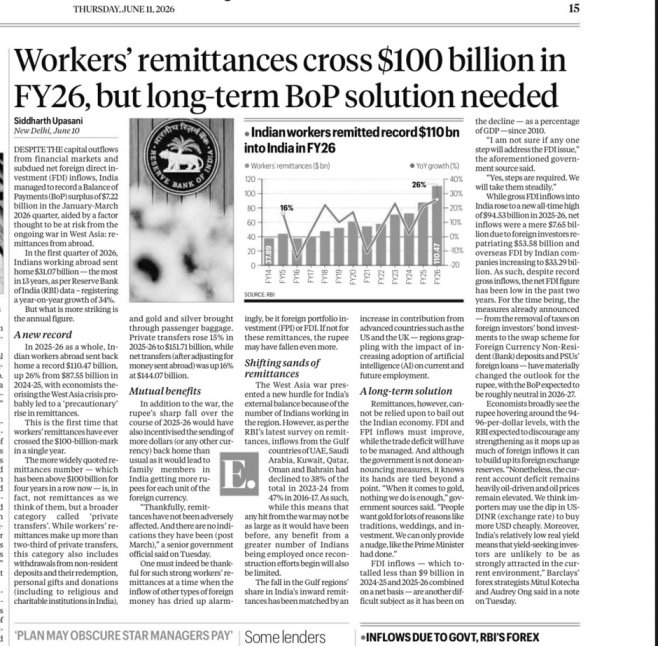
- India's workers' remittances crossed the $100 billion mark for the first time ever in FY26 reaching a record $110.47 billion, up 26% from $87.55 billion in FY24-25. This is the first time remittances have crossed $100 billion in a single year.
- Q1 FY26 (January–March 2026): Indians working abroad sent home $31.07 billion - the most in 13 years - registering 34% YoY growth.
| Term | Includes | FY26 figure |
| Workers' remittances | Money sent home by Indian workers abroad through banking channels | $110.47 billion |
| Private transfers | Workers' remittances + NRI deposits + gifts + donations + gold/silver baggage | $151.71 billion |
| Net transfers | Private transfers minus money sent abroad by Indians | $144.07 billion |
Balance of Payments (BoP) Context
- Despite capital outflows from financial markets and subdued net FDI inflows, India recorded a BoP surplus of $7.22 billion in Q1 FY26 (January–March 2026) the remittances acted as the key stabiliser.
Remittances Rose Causal Factors-
1. West Asia war effect - The ongoing West Asia war created a "precautionary" rise Indians working in Gulf countries sent more money home fearing job loss, conflict escalation, and economic uncertainty.
2. Rupee depreciation incentive - The rupee's sharp fall during 2025-26 incentivised sending more dollars (or any currency) home each unit of foreign currency fetches more rupees for family members. Classic "valuation effect" on remittances.
3. Shifting geography Gulf declining, advanced economies rising - The Gulf countries' (UAE, Saudi Arabia, Kuwait, Qatar, Oman, Bahrain) share in India's inward remittances declined from 47% in 2016-17 to 38% in 2023-24.Advanced countries like the US and UK are increasing their contribution reflecting the impact of AI on employment and the growing Indian tech diaspora.
The FDI Problem -
- The article raises a critical concern remittances cannot be relied upon to bail out the Indian economy long-term.
Net FDI problem: Gross FDI was a record $94.53 billion in FY26 but net FDI was only $7.65 billion because -
- Foreign investors repatriated $53.58 billion (profits, dividends, asset sales).Indian companies invested $33.29 billion abroad (outward FDI).
FPI problem - FDI and FPI inflows together totalled less than $9 billion in both FY25 and FY26 combined on a net basis a structural weakness.
Net FDI as % of GDP - Has been declining since 2010 at historic lows in FY26 despite record gross inflows.
Structural concerns cited -
- Current account deficit remains heavily oil-driven because oil prices elevated.
- India's relatively low real yield means yield-seeking investors are less attracted.
- US-DINR exchange rate ; importers may use the dip to buy more USD cheaply.
- BoP expected to be w in FY26-27.
Rupee Outlook
- The rupee is hovering around ₹94–96/dollar levels. RBI is expected to discourage any strengthening mopping up as much of foreign inflows as it can to build forex reserves.
Measures already announced to support BoP-
- Removal of taxes on foreign investors' bond investments.
- Swap scheme for FCNR(B) (Foreign Currency Non-Resident Bank) deposits.
- PSUs' foreign loans facilitated.