
-
News
-
The USA and Israel launched a joint military operation against Iran on February 28, 2026.
-
-
4 objective of war (as given by Trump in Feb 28 Address)-
-
To destroy Iran’s missile capabilities,
-
Regime change,
-
prevent it from obtaining a nuclear weapon, and
-
ensure that it cannot continue to support allied armed groups (Hamas, Hezbollah, Houthis, etc.)
-
Though objectives of this war have changed significantly with time.
|
Country |
Operation Name |
Objective |
|
USA |
Operation Epic Fury |
Started Feb 28, 2026. Aimed at dismantling Iran's missile/nuclear infrastructure and security apparatus. |
|
Israel |
Operation Lion’s Roar |
Pre-emptive strikes on Tehran and nuclear sites (Coordinated with Epic Fury). |
|
Iran |
Operation True Promise 4 |
Iran's retaliatory missile and drone strikes against Israel and US regional bases. |
Law related to Wars
|
Legal Instrument |
Core Objective & Mandate |
Key Articles & Provisions |
|
UN Charter |
To save future generations from the scourge of war; maintain international peace and security. |
Art 2(4): Prohibits threat/use of force against 'territorial integrity' or 'political independence' of another state. |
|
UN Charter (Exceptions) |
Restricts the “use of force” unless authorised by the UN Security Council. |
Art 51: Sole exception; permits use of force in self-defence against an actual armed attack. |
|
International Humanitarian Law (IHL) |
Governs how war is fought (Jus in bello); ensures humane conduct regardless of how war started. |
1949 Geneva Conventions: Protects wounded, sick, POWs, and civilians; restricts brutal weapons/methods. |
|
Rome Statute |
Establishes the International Criminal Court (ICC) for individual accountability. |
Defines intentional targeting of civilians, schools, and hospitals as War Crimes. |
|
UNCLOS (United Nations Convention on the Law of the Sea) |
Governs maritime conduct mainly during peacetime but does not regulate naval warfare during armed conflicts. |
|
UN Security Council Authorisation: Military action may also occur with UNSC approval under Chapter VII.
Iran: Leadership Transition & Key Appointments
The assassination of the Supreme Leader on Feb 28 has led to a shift:
|
Position |
Individual |
|
Late Supreme Leader |
Ayatollah Ali Khamenei |
|
Interim Supreme Leader |
Alireza Arafi |
|
New Supreme Leader |
Ayatollah Mojtaba Khamenei |
|
President |
Masoud Pezeshkian |
|
Foreign Minister |
Abbas Araghchi |
|
Secy. Security Council |
Ali Larijani (Deceased) |
|
New Secy Security Council |
Md Bagher Zolghadr |
Places in the news
-
Iran:
-
Minab:
- In this area of Iran, a school was airstriked, killing 168 school children.
-
Kharg Island
- Recently attacked by the USA. It handles nearly 90% of Iran’s oil exports.
-
Strait of Hormuz
-
The Strait of Hormuz carries 85% of India’s LPG, 55% of LNG..
- 20% of global oil supply pass through it.
-
At its narrowest point, it is about 32 kilometres (20 miles) across.
-
-
Natanz: Nuclear research facility in Iran, recently attacked.
-
-
UAE: Port of Fujairah, Habshan gas field, Shah gas Field.
-
Qatar: Ras Laffan Industrial City.
-
Israel: Negev nuclear research centre, Dimona.
-
Kuwait: Mina Al Ahmadi
-
South Pars / North Dome Gas Field: The world’s largest natural gas field. It is located deep under the Persian Gulf and is shared by Iran (South Pars) and Qatar(North Dome).
Major Global Oil Benchmarks
-
Brent crude oil
-
Origin: North Sea oil fields
-
Most widely used global benchmark
-
Used for: Europe, Africa, Middle East exports; Seaborne oil trade pricing.
-
West Texas Intermediate
-
Benchmark for North America and inland benchmark (pipeline-based)
-
Dubai/Oman crude benchmark
-
Used mainly for Middle East exports to Asian markets
IRIS Dena
-
This frigate was torpedoed by the USS Charlotte (US Navy Submarine)
-
The ship was operating 20 NM west of Galle in the SAR region under Sri Lanka’s responsibility.
-
The Indian Navy promptly launched its SAR (Search and Rescue) efforts led by INS Tarangini
-
Participated in the Milan Exercise.
-
Other participating ships include IRIS Bushehr, IRIS Lavan.
Missiles used
-
Iran - Cluster Bomb Missile (Khorramshahr-4), Shahab-3, Fateh Series, Qader cruise missiles, Fattah 2 (Hypersonic ballistic missile).
-
Israel- Jericho Missiles, Arrow-3 (Interceptor)
-
USA- Tomahawk Land Attack Missile, Patriot Missile Defence System, THAAD.
About Force Majeure
-
News: In the backdrop of the United States-Israel war on Iran, Gulf countries, including Qatar, Bahrain and Kuwait, have declared force majeure on gas exports.
-
A 'Force Majeure' provision serves as a protective legal shield, suspending performance obligations during catastrophic events such as natural disasters that lie beyond the reasonable control of the contracting parties.
Port of Refuge
-
Adani Ports and Special Economic Zone Ltd (APSEZ) established India’s first ‘Port of Refuge’ at Dighi Port (Mumbai) and Gopalpur Port (Odisha).
-
A Port of Refuge (PoR) is a designated safe location where ships in distress—due to fire, collision, or mechanical failure—can seek shelter. Its purpose is to stabilise the vessel, safeguard lives, and minimise environmental damage.
Steps taken by the Government of India to deal with the West Asia War:
-
Official Position: Strong advocacy for dialogue, diplomacy, and de-escalation. Condemns attacks on civilians, energy/transport infrastructure, and obstruction of international waterways (Strait of Hormuz).
-
Domestic Vigilance: Heightened alert across coastal, border, cyber, and strategic domains. Strict directives were issued to states to prevent crisis exploitation, black-marketing, and hoarding.
-
India has evacuated over 550 of its nationals from Iran through Armenia.
-
As part of the coordinated whole-of-government response to the crisis situation, an Inter-Ministerial Group (IMG) on Supply Chain Resilience was operationalised on March 02, 2026 to monitor the situation and coordinate facilitation measures.
-
The Govt of India formed 7 empowered committees on the West Asia Crisis to deal with the potential long-term impacts of the West Asia conflict.
-
Excise Duty: Govt of India has reduced excise duty on petrol and diesel by Rs. 10/litre.
-
Export Levy: Further, the Government of India has imposed an export levy of Rs 21.5 per litre on diesel and Rs 29.5 per litre on aviation turbine fuel (ATF) to ensure availability of these products in the domestic market.
-
To ensure India's energy security, the government has diversified its supply chain by expanding its import basket from 27 to 41 nations in the last 11 years.
Natural gas
-
India’s total natural gas consumption is approximately 189 million cubic meters per day. Out of this, about 97.5 million cubic meters per day is produced domestically. Due to unforeseen circumstances, around 47.4 million cubic meters per day of supply has been affected.
-
The Union Govt has invoked the Essential Commodities Act and issued the Natural Gas Control Order on 9 March 2026-
-
To regulate LPG & natural gas supply, ensuring fair distribution & preventing hoarding.
-
The Government of States/UTs has to play a primary role in monitoring and regulating the supply situation of essential commodities, including Petrol, Diesel and LPG.
Natural Gas and Petroleum Products Distribution (Through Laying, Building, Operation and Expansion of Pipelines and Other Facilities) Order, 2026
-
It was passed under the Essential Commodity Act, 1955.
-
The Order establishes a time-bound, streamlined framework for pipeline expansion by resolving land access and regulatory bottlenecks.
Key objectives include:
-
Accelerated PNG Expansion: Boosting last-mile connectivity in residential sectors.
-
Energy Transition: Facilitating the shift to cleaner fuels to enhance energy security.
-
Economic Impact: Advancing India toward a gas-based economy through rapid infrastructure development.
|
Crude Oil
-
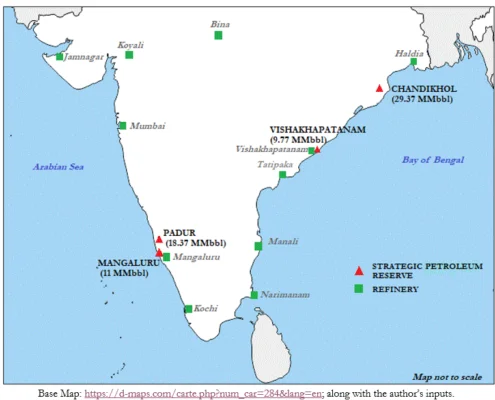
Strategic Petroleum Reserve (SPR):
-
Over 5.3 MMT (Million Metric Tonnes) in SPR.
-
-
-
Expansion: increase capacity by an additional 6.5 MMT
-
Phase-I SPR Facilities (5.33 MMT): Currently operational at three locations
-
Visakhapatnam (Andhra Pradesh)
-
Mangaluru (Karnataka)
-
Padur (Karnataka)
-
-
Phase-II (approved in 2021, with an additional 6.5 MMT): Future expansion planned at
-
Chandikhol (Odisha)
-
Padur Phase-II
-
-
Note: Buffer: Oil marketing companies maintain independent commercial reserves.
-
Operation Sankalp
-
News: Indian Naval warships escort Indian-flagged merchant vessels Shivalik, Nanda Devi, and Jag Laadki from the Gulf of Oman.
-
About Operation Sankalp
-
Launched: 19 June 2019
-
Objective: Ensure the safe passage of Indian-flag vessels and protect India’s maritime trade and energy supply lines by the Indian Navy.
Operation Urja Suraksha
-
Operation Urja Suraksha is the strategic naval mission launched by the Indian Navy on March 25, 2026.
-
This is to ensure the safe movement of cargo ships in conflict-affected areas.
-
Under this operation, more than five frontline warships, which include destroyers and frigates, have been deployed in the Gulf of Oman.
Resilience & Logistics Intervention for Export Facilitation (RELIEF) scheme
-
Launched by: Ministry of Commerce and Industry under the Export Promotion Mission (EPM)
-
Aim: To support Indian exporters affected by extraordinary freight escalation, heightened insurance premium and war-related export risks arising from disruptions in the Gulf and wider West Asia maritime corridor.
-
Financial Outlay: Rs 497 Crores.
-
Coverage: RELIEF covers both eligible past shipments and prospective exports, with a strong focus on MSME support.
-
Intervention will be funded under EPM and reviewed periodically based on geopolitical developments.
-
Nodal Implementing Agency: Export Credit Guarantee Corporation of India Ltd.
- Key Features
-
Up to 100% extra risk coverage for insured consignments during the eligible period February 14, 2026, to March 15, 2026), and
-
up to 95% support for exporters planning to ship upcoming consignments during the next three months (March 16, 2026, to June 15, 2026).
-
-
Up to 50% reimbursement (maximum limit ₹50 lakh) for eligible non-ECGC-insured MSME exporters.
-
|