What is it?
Many fundamental particles in nature exist in three similar versions, known as “flavours” or “generations.”
For example, electron, muon, and tau are all leptons with identical charges and interactions, yet they possess widely different masses.
The muon is nearly 200 times heavier than the electron, while the tau is even more massive.
Why is it a Puzzle?
The Standard Model of particle physics successfully explains how particles interact, but it does not explain:
Why there are exactly three generations
Why their masses differ by such large factors
Why some particles can transform from one flavour into another
Flavour Mixing
Neutrinos can oscillate from one flavour to another as they travel.
Quarks also undergo flavour changes during weak interactions.
These processes are mathematically described through:
Cabibbo–Kobayashi–Maskawa (CKM) matrix for quarks
Pontecorvo–Maki–Nakagawa–Sakata (PMNS) matrix for neutrinos
Why Does It Matter?
The flavour puzzle is closely related to the question of why the universe contains more matter than antimatter.
The CP violation predicted by the Standard Model is insufficient to fully explain this observed imbalance.
Possible Solutions
Physicists are exploring several possible explanations, including:
New fundamental forces
Extra spatial dimensions
Hidden symmetries
Physics beyond the Standard Model
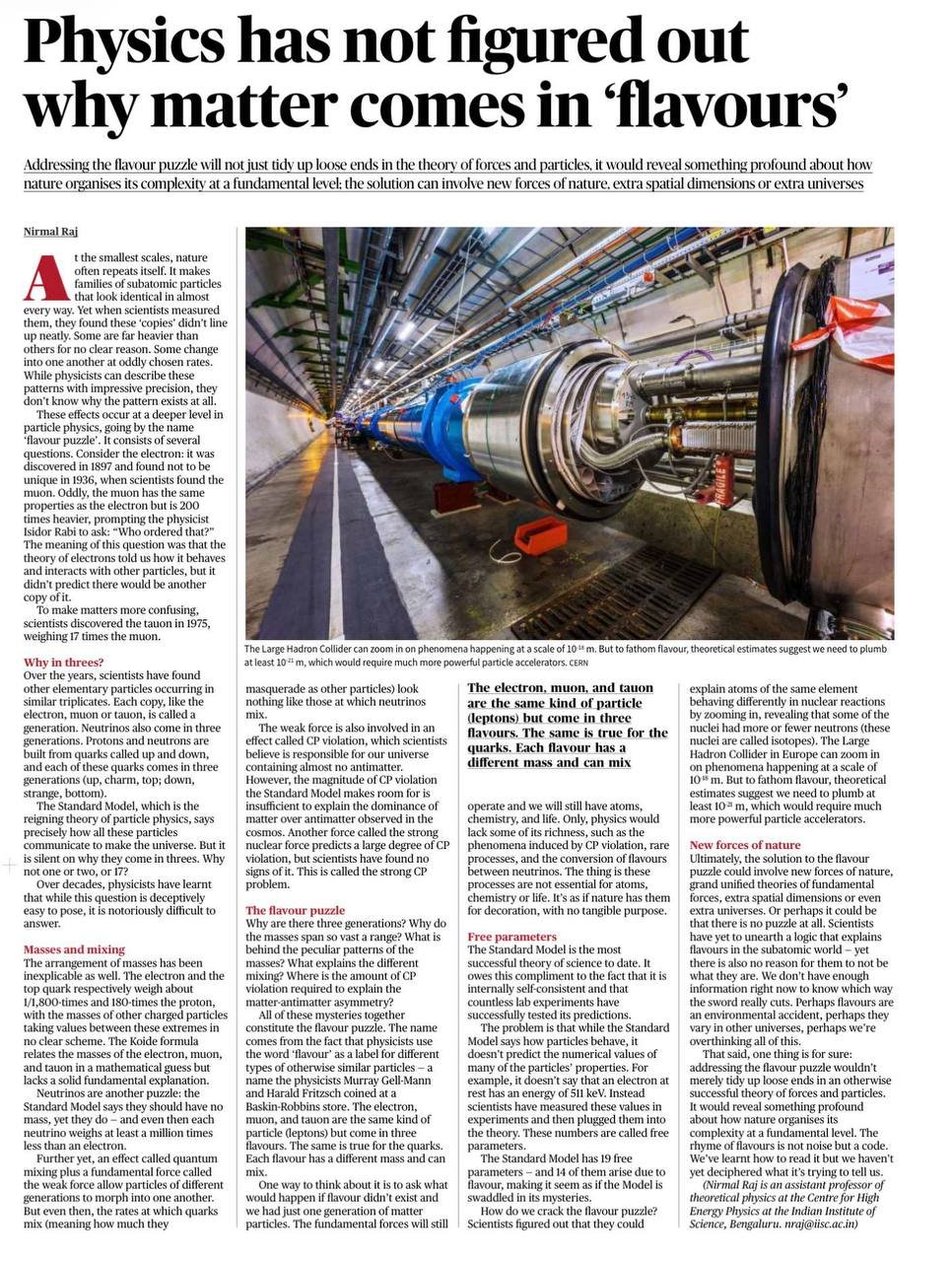
Ongoing experiments at the Large Hadron Collider (LHC) are actively searching for clues.
Conclusion
The flavour puzzle highlights that current particle physics remains incomplete.
Solving it could explain the origin of matter in the universe and uncover deeper fundamental laws of nature.
Other Important Current affairs Videos👇.
GIB Explained: India’s Critically Endangered Bird. Click Here👈
भारत औद्योगिक विकास योजना (BHAVYA) औरस्मॉल हाइड्रो पावर (SHP)विकास योजना Click Here👈