
Introduction
- India achieved a major strategic milestone by successfully testing an Agni-series missile equipped with MIRV technology, under the mission named “Mission Divyastra.”
- This achievement significantly enhances India’s nuclear deterrence capability and strategic defence strength. With this success, India has joined the group of advanced nations possessing sophisticated MIRV (Multiple Independently Targetable Re-entry Vehicle) technology.
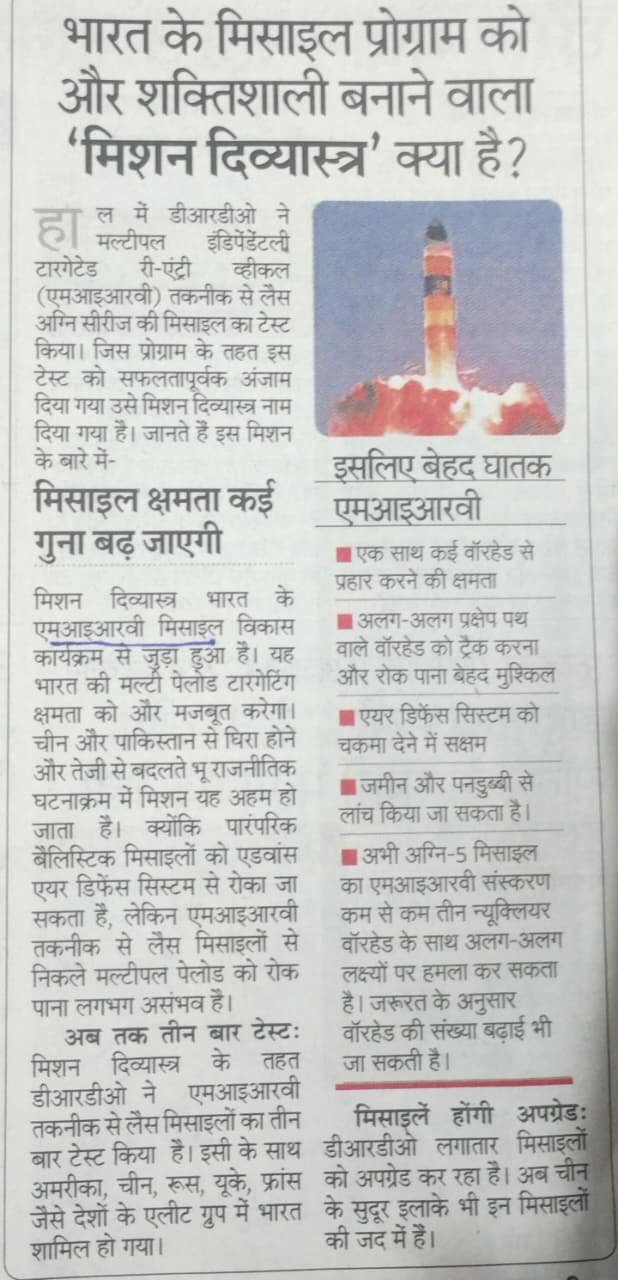
What is Mission Divyastra?
⇒Mission Divyastra is associated with India’s MIRV missile development programme.
⇒Under this technology:
- A single ballistic missile can carry multiple warheads
- Each warhead can independently strike different targets
⇒This greatly increases the destructive and strategic capability of a missile system.
What is MIRV Technology?
- Full Form:- Multiple Independently Targetable Re-entry Vehicle
- MIRV is a technology in which:
- One missile carries multiple nuclear or conventional warheads
- Each warhead follows a separate trajectory toward different targets
Key Features of MIRV Technology
1. Multiple Target Engagement
- A single missile can attack several strategic targets simultaneously.
2. Difficult to Intercept
- Since warheads separate and move independently:
- Tracking becomes extremely difficult
- Missile defence systems face major challenges intercepting them
⇒ This makes MIRV-equipped missiles highly lethal.
3. Stronger Nuclear Deterrence
- It significantly strengthens India’s second-strike capability.
4. Long-Range Precision Capability
- Missiles such as Agni-5 can strike targets thousands of kilometres away with high precision.
Strategic Importance for India
1. Important in the Context of China and Pakistan
- Both China and Pakistan are rapidly modernising their missile systems.
- MIRV capability improves India’s strategic balance and deterrence posture.
2. Strengthening Nuclear Deterrence
- It reinforces India’s doctrine of “Credible Minimum Deterrence.”
3. Enhanced Second-Strike Capability
- Even in the event of a nuclear attack on India, retaliatory capability remains intact.
4. Boost to Defence Self-Reliance
- The success reflects DRDO’s technological capabilities and India’s growing defence self-sufficiency.
Agni-5 and Mission Divyastra
- Agni-5 is India’s long-range ballistic missile
- Range: approximately 5000+ km
- Nuclear-capable missile
- With MIRV integration, its operational capability has increased substantially.
Countries Possessing MIRV Technology
- Before India, MIRV technology was primarily possessed by:
- United States
- Russia
- China
- France
- United Kingdom - India has now entered this elite strategic group.
India’s Expanding Missile Capability
- India is continuously modernising its strategic arsenal through projects such as:
- Agni missile series
- Prithvi missiles
- BrahMos
- Astra missile
- K-4 and K-5 SLBMs
- Project Kusha
Challenges Ahead
- Hypersonic weapons race
- Advanced missile defence systems
- Cyber and space warfare
- Risk of regional arms race
Global Implications
MIRV capability will:
- Strengthen India’s strategic position
- Influence the Asian security balance
- Enhance India’s global defence credibility
Important Facts & Data
- DRDO successfully tested a MIRV-capable missile
- A single missile can deploy multiple warheads
- Each warhead can independently strike separate targets
- The MIRV version of Agni-5 is believed to carry at least three nuclear warheads
Relevance for UPSC / RAS
Important Topics:
- DRDO
- MIRV Technology
- Nuclear Doctrine
- Ballistic Missile Defence
- India’s Strategic Security
- Defence Technology
Conclusion
- Mission Divyastra marks a historic advancement in India’s missile and defence technology. MIRV capability will significantly enhance India’s nuclear deterrence and strategic strength. This is not merely a missile test, but a symbol of India’s emergence as a technologically advanced and strategically capable power.