
News:-
-On March 25, 2026, the Union Cabinet chaired by Prime Minister Narendra
Modi approved India's Nationally Determined Contribution (NDC) for the
period 2031 to 2035.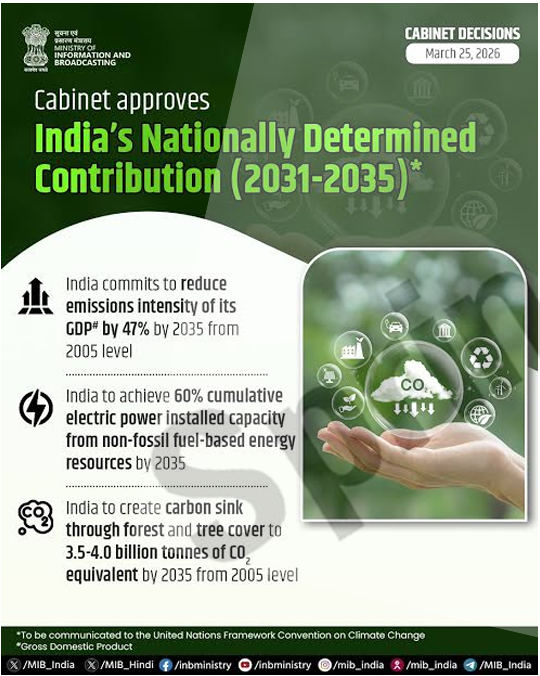
Key Ponts:-
01. To be submitted to the United Nations Framework Convention on Climate Change (UNFCCC) under the Paris Agreement.
02. Well-suited to Viksit Bharat 2047 vision and to achieve the target of net zero emissions by 2070.
03. Based on the results of the first Global Stocktake (GST) and the principle of common but differentiated responsibilities and respective capabilities (CBDR-RC).
Key targets:-
| 01. .Emission intensity -To reduce the emission intensity of its gross domestic product (GDP) by 47% by 2035 compared to 2005 ‣ 36% reduction in emission intensity between 2005 and 2020. |
02. Non-Fossil Energy Capacity- Achieve 60 percent of cumulative electric power installed capacity from non-fossil fuel-based energy resources by 2035. ‣ Share of non-fossil fuel energy resources in installed electric capacity by February 2026 - 52.57% |
03. Carbon Sinks - Create an additional carbon sink of 3.5 to 4.0 billion tons of CO₂ equivalent through increased forest and tree cover by 2035. ‣ Create a carbon sink of 2.29 billion tons of carbon dioxide equivalent by 2021. |
- Nationally Determined Contributions (NDCs) :-
-Non-binding national climate action plans under the Paris Agreement.
-Outlines the country's efforts to reduce greenhouse gas emissions and adapt to the impacts of climate change.
-According to Article 4 of the Paris Agreement, each Party is required to prepare,communicate, and maintain its NationallyDetermined Contributions (NDCs)
-Submitted by Parties to the United Nations Framework Convention on Climate Change (UNFCCC) every 5 years.
-First submitted in 2015, followed by a second round in 2020/21 and a third round in 2025.
India's Nationally Determined Contributions (NDCs) and Targets
| Areas | NDC 2015 | NDC 2022 | NDC 2031-35 |
| Reduction in emission intensity to GDP (from 2005 levels) |
33-35% | 45% | 47% |
| Share of non-fossil fuels in total installed power capacity |
40% | 50% | 60% |
| Creation of additional carbon sinks through forest and tree cover (from 2005 levels) |
2.5-3 billion tonnes of CO₂ equivalent |
2.5-3 billion tonnes of CO₂ equivalent |
3.5-4.0 billion tons of CO₂ equivalent |